
ID card printing process explained?

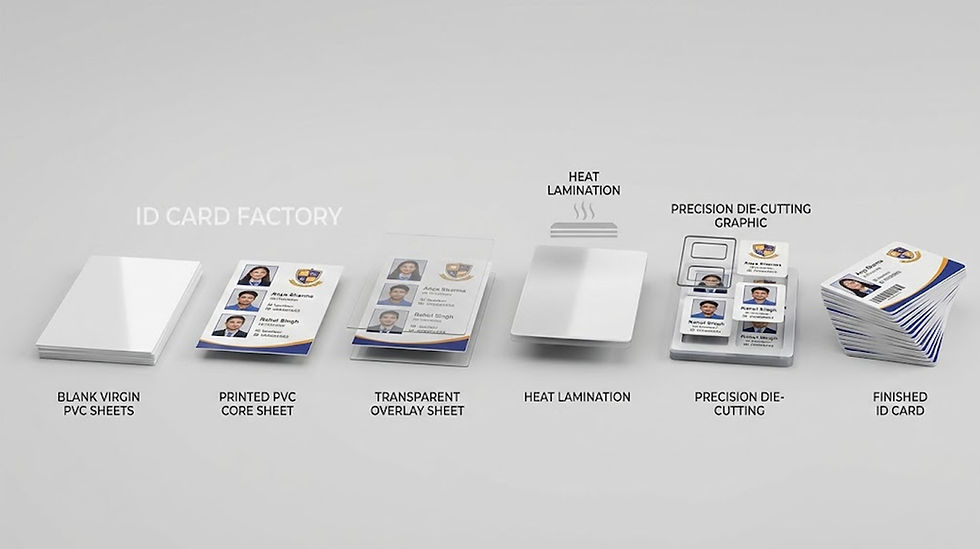
The ID card printing process is a controlled manufacturing workflow that converts raw PVC material into strong, accurate, and professional ID cards used by schools, offices, factories, hospitals, and institutions. Each stage has a specific purpose, and skipping any step directly affects quality.
Below is a clear, practical explanation of how professional ID cards are actually made.
Why the Printing Process Matters
ID cards are handled daily. If the process is weak, common problems appear quickly:
Lamination starts peeling
Cards crack near the slot area
Photos and text fade
Barcodes stop scanning
A professional process ensures consistency, durability, and reliability in bulk production.
Complete ID Card Printing Workflow
Stage 1: PVC Base Material Selection
The process starts with selecting virgin CR80-grade PVC sheets.This material provides:
Uniform thickness
Flexibility without cracking
Stability during printing and lamination
Low-grade or recycled PVC is avoided at this stage.
Stage 2: Card Design & Data Structuring
Before printing, the card layout is finalized:
Logo and background design
Photo, name, ID number
Department / class details
Barcode, QR code, or RFID placement
For bulk orders, data is structured using Excel/CSV files to maintain accuracy.
Stage 3: High-Resolution Printing
The approved design and variable data are printed on a PVC core sheet using professional printers.This stage ensures:
Sharp photos
Clear text
Accurate brand colors
At this point, the print is still exposed and needs protection.
Stage 4: Protective Overlay Placement
Transparent PVC overlay films are placed:
One on the front
One on the back
These overlays protect the printed surface from scratches, moisture, and friction.
Stage 5: Heat & Pressure Lamination
All layers are fused together using heat and pressure.This step:
Permanently seals the card
Removes air gaps and glue
Prevents peeling and bubbling
Increases card strength
This is the most critical stage of the process.
Stage 6: Cooling & Sheet Stabilization
After lamination, sheets are cooled and stabilized to:
Prevent warping
Maintain flatness
Ensure uniform thickness
This step is essential for clean cutting.
Stage 7: Precision Cutting
Laminated sheets are cut into individual cards with:
Smooth sealed edges
Standard CR80 size
Professional finish
Poor cutting leads to sharp edges and uneven cards.
Stage 8: Slot Punching / Hole Punching
If required, slot or hole punching is done after lamination so the card remains strong at stress points like lanyard slots.
Stage 9: Quality Inspection
Each batch is checked for:
Print clarity
Edge sealing
Slot strength
Barcode / QR readability
Overall finish consistency
Only approved cards move forward.
Stage 10: Packing & Dispatch
Finished cards are:
Packed securely
Sorted as required (department-wise / class-wise)
Dispatched with tracking
📊 Chart: Professional ID Card Process vs Shortcut Printing
Process Area | Professional Workflow | Shortcut Method |
PVC material | Virgin CR80-grade | Mixed / recycled |
Design handling | Structured & approved | Ad-hoc |
Printing | High-resolution | Basic |
Surface protection | PVC overlays | None / thin film |
Lamination | Heat & pressure | Cold adhesive |
Cutting | Precision | Manual |
Slot punching | After lamination | Before lamination |
Quality check | Batch-wise | Skipped |
Who Follows the Complete Process?
Factory-direct manufacturers control all stages in-house. One such example is
ID CARD FACTORY
which follows the complete professional ID card printing workflow without outsourcing or shortcuts.
What Goes Wrong When Steps Are Skipped
No overlays → scratches & fading
Cold lamination → peeling
Early slot punching → cracks
No inspection → inconsistent batches
Most ID card failures trace back to process shortcuts.
Final Summary
The ID card printing process is a step-by-step manufacturing system, not simple plastic printing. From PVC selection and design preparation to heat lamination, cutting, and inspection, every stage contributes to the final card’s performance.
When the full process is followed correctly, the result is clean, durable, and professional ID cards suitable for daily institutional use.



Comments